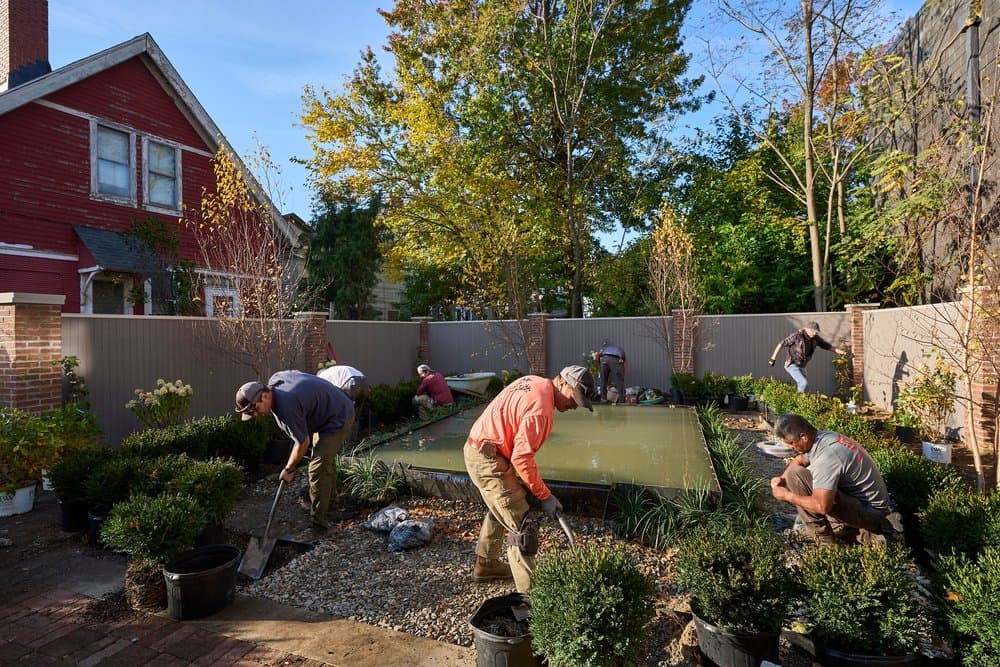
Why Site Prep Comes First
Every finished landscape people notice, the patio, the planting, the lighting, the pool, sits on top of work no one ever sees. Site prep is that invisible layer, and it is the single biggest predictor of whether the visible work holds up. A beautiful paver patio on a poorly prepared subgrade heaves and settles within a few winters. A planting plan installed over the wrong grade drowns half its plants the first wet spring.
Getting site prep right means doing things in the correct order. Grade first, then excavation and base, then hardscape, then planting and finish work. Reversing any of that creates expensive rework, because a crew ends up tearing out finished work to fix a problem that should have been solved before the surface ever went down. On a pool project the stakes are higher still, since the pool shell, the surround, and the yard all depend on the ground being shaped correctly before anything is set.
For Northeast Ohio, prep also has to reckon with conditions that are easy to ignore in a dry August but punishing every spring: heavy clay, more than 40 freeze-thaw cycles a year, and drainage patterns that only reveal themselves after a hard rain. Walking a site during a storm tells us more about what the prep needs to accomplish than any set of drawings.
Grading and Earthwork
Grade is where every site prep job starts, because grade decides where water goes and where every downstream elevation lands. Every flat or low surface has to slope away from structures at a minimum of 2%, roughly a quarter inch of drop per foot. Patio elevations, wall heights, and bed edges are all set relative to the established grade, which is why regrading has to happen before the first course of hardscape goes in, not after.
Earthwork on a residential site usually means a mix of cuts and fills: cutting high spots down to design grade and filling low pockets that would otherwise collect water. The finished contours have to shed water toward a legitimate outlet while keeping the surface usable. Get this stage right and a large share of drainage complaints disappear before any pipe is buried.
Working with Northeast Ohio Clay
Most yards in Cleveland's eastern suburbs sit on heavy clay left behind by glacial Lake Erie. Clay is the constraint that shapes nearly every site prep decision we make. It drains slowly, compacts hard under traffic, holds water at the surface, and swings between waterlogged in spring and cracked hard in late summer. Layer freeze-thaw on top and the soil heaves and shifts season after season.
Clay changes how fills get placed. Material dumped in one pass will settle again within a couple of seasons and recreate the same low spot, so fills have to be compacted in lifts to hold their shape. Under hardscape, organic topsoil has to be stripped away first, because organic material left under a compacted stone base is exactly what causes long-term settling. And because clay will not simply percolate water down through itself, infiltration-based fixes that work in sandy soil often fail here, which pushes the design toward collecting water and physically moving it to an outlet.
None of this is glamorous, but it is the difference between a base that stays put for decades and one that fails in a few winters. The prep has to respect what the soil actually does, not what we wish it did.
Tying Drainage into the Prep
The best time to solve drainage is during site prep, while the ground is already open and the grade is being established. Trenching for French drains, burying solid PVC from downspouts, and setting area drains at low points are all far cheaper to do before hardscape and planting go in than to retrofit afterward. On a pool project this is non-negotiable: if the yard already has a drainage problem, it has to be solved before the shell goes in, not after.
In clay, the reliable approach is to collect water and route it to a legitimate outlet, ideally to daylight on a downhill slope. We wrap perforated pipe in a non-woven geotextile sock and line trenches with filter fabric before backfilling with washed stone, which is what keeps clay fines out of the system and lets it last 20 to 30 years instead of silting up in five. We covered the full diagnosis-and-fix process in our guide to backyard drainage in Northeast Ohio.
Coordinating drainage with grading during prep means the whole system, surface slope and subsurface pipe and downspout tie-ins, is designed as one thing rather than a set of disconnected patches added over time.
Equipment and Site Access
Site prep is a heavy-equipment job. Compact excavators, skid steers, and dump trucks all need a route into the work area, and on tight suburban lots in Shaker Heights, Cleveland Heights, and Pepper Pike, access is frequently the single biggest constraint on the entire project. Planning it early means deciding which fence section comes out, which plantings are temporary, and where equipment can stage without destroying the parts of the yard you intend to keep.
Spoils are the other half of the equation. Clay is heavy, and a pool excavation or a significant regrade generates far more material than can be redistributed on site, so a real haul-off plan has to exist before the digging starts. On larger or standalone jobs, this is specialized excavation work in its own right. Pittsburgh-area excavation specialists like Dirt Works handle the dig, grade, and haul-off before any landscaping goes in, and their project write-ups are a useful window into how excavation-first sequencing plays out in a comparable clay-and-freeze-thaw climate across Western Pennsylvania.
One rule applies to every job regardless of scope: always call 811 before digging. Ohio law requires utility locates 48 hours ahead, and buried gas, electric, and fiber are more common, and far more expensive to hit, than most homeowners expect. When the ground is prepped correctly, everything built on top of it has a real chance of lasting. Reach out through our contact page and we will walk the site with you.
